News
Island wine establishes itself as a global category at the Island Wines Summit
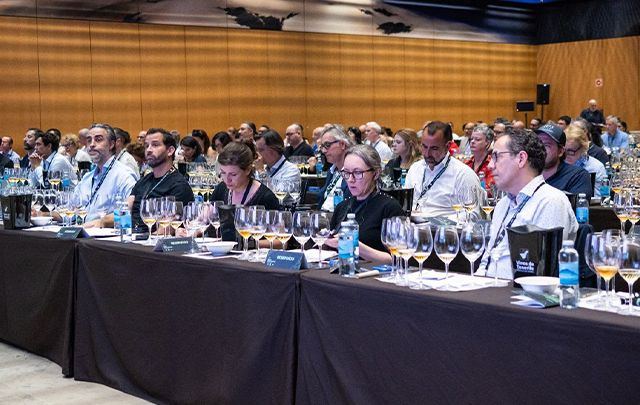
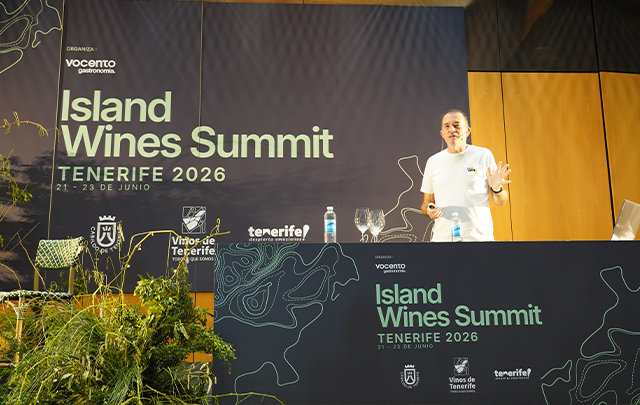
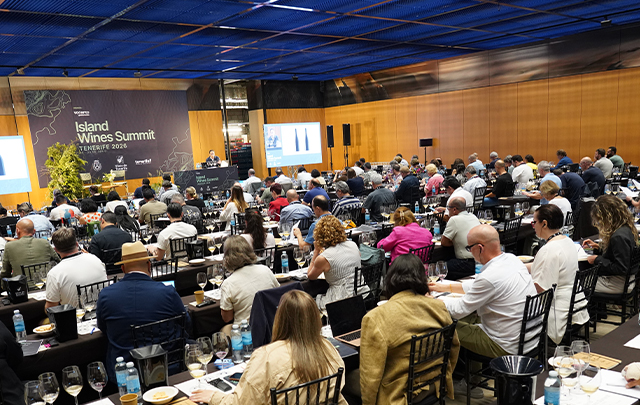
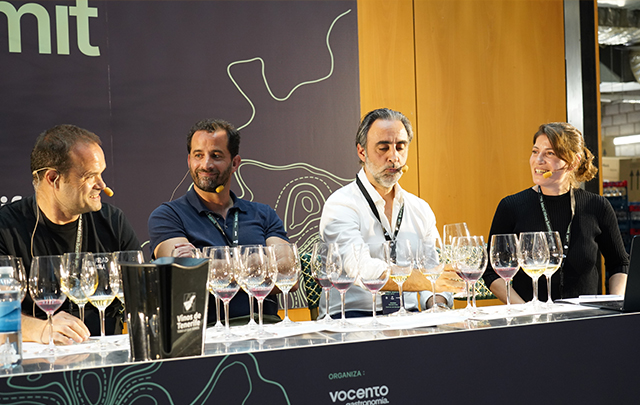
Following the exceptional masterclass held yesterday by Josep Roca, sommelier at El Celler de Can Roca*** (Girona), as the opening event of the first edition of the Island Wines Summit, the international island wine conference began its first full day in Tenerife today. The conference, organised by Vocento Gastronomía, with the Cabildo de Tenerife and Turismo de Tenerife as institutional sponsors and in collaboration with Vinos de Tenerife, opened with a speech by the director of Vocento Gastronomía, Benjamín Lana, who argued that “nature is not merely a backdrop, but a teacher that compels us to learn to observe, listen and collaborate”, something that those who work in vineyards and wineries know only too well. He concluded by championing uniqueness, summed up in a resounding “our identities matter”.
The Island Wines Summit 2026 opened the discussion on island wines with a digression on minerality, a relatively new term in the wine lexicon, increasingly present in tastings and descriptions but difficult to pin down. Jamie Goode, a wine journalist with an academic background in plant biology and founder of wineanorak.com, was tasked with trying to extract the truth from the scientific evidence on minerality. An extremely complicated task because, as Goode explained, “even amongst wine professionals themselves, there are different perceptions of the term: for some it is a sensation on the palate, others link it to the sense of smell, and for many it is a combination of both”. Indeed, paraphrasing Wendy Parr—a scientist specialising in sensory perception and an oenologist—the journalist posed the question of where minerality comes from: “Is it in the glass or in the taster’s sensory experience?”. The answer, as the British journalist pointed out, is not straightforward because “tasting is not an exact science” and “minerality is multifactorial; there are many factors that influence it”. As a sensory attribute, minerality can be observed in various elements: volatile sulphur compounds, for example, have a strong aromatic profile; salinity enhances minerality; and nutrient deficiency in the soil also affects the yeasts and the final character of the wine. Jamie Goode also emphasised the importance of being aware that “minerality can be overshadowed by viticultural decisions. With minimal intervention, there is more minerality; the opposite is also true. For example, if you use a lot of oak, the minerality is overshadowed”. This remains an open debate since, as Goode pointed out, “25 years ago nobody talked about minerality and now the term is everywhere; and although the link between soil and wine is not direct—because stone does not dissolve—we do know that it affects the wine’s outcome: the soil influences the composition of the grape and, through fermentation, the wine itself”.
Building on his theory of molecular harmonies, and reinforcing the idea that minerality is complex, François Chartier has also addressed the subject of minerality. For the Canadian based in Barcelona, it is not a literal transposition from soil to wine but “a neurosensory perception that evokes, through various stimuli, a mental image of a place”. With this, Chartier stated: “I do not wish to undermine the concept of minerality. I agree that it exists, but it does so as a perception, an interpretation. Mineralisation can be measured; minerality is perceived. With minerality, science and emotion converge.”
And whilst, as Jamie Goode has demonstrated, encapsulating the concept of minerality is difficult, defining island wines is no easier either. This was affirmed by Pascaline Lepeltier, Master Sommelier and director of beverages at Chambers (New York, USA), with whom conference attendees had the opportunity to explore how the concept of island wine has been developed over the last 50 years. Lepeltier recognised island wine as “a distinct winemaking concept, a geo-historical reality in which the ideas of terroir, maritime influence and heroic viticulture merge”. Yet, at the same time, she also called for “greater individuality when describing them, as it is very difficult to group them all under a single label”. The French sommelier, based in New York, recalled how the idea of island wines began to take shape during the 1980s, gradually becoming a recognised concept by the 2000s, until it is now “an established and undisputed category”.
Lepeltier recalled the role played by the Greek islands in the 1980s as pioneers in reviving their winemaking tradition and exporting wines associated with a sensuality and a very distinctive way of understanding life. This was a path also followed by Corsica with “the revival of its own vineyards and grape varieties”. Sicily and the Canary Islands were the next regions to expand their island wines. Mount Etna became a catalyst: “that was the moment when we began to talk about terroir, limestone wines, volcanic wines…”. Winemakers and vintners understand the value of their own heritage but are also connoisseurs of the world’s great wines, and “their aim is to create those great wines on their own islands”. Currently, Portugal and Japan represent a new phase for island wines and their export, wines backed by carefully crafted storytelling. “At present, there’s no problem selling certain wines, despite their price, because they have a story behind them,” says Pascaline, an expert on the New York market, “which is always a preview of what’s to come tomorrow, with many wine experts willing to follow you if you offer them something different and worthwhile”.
From island to island, from the Mediterranean to the Atlantic
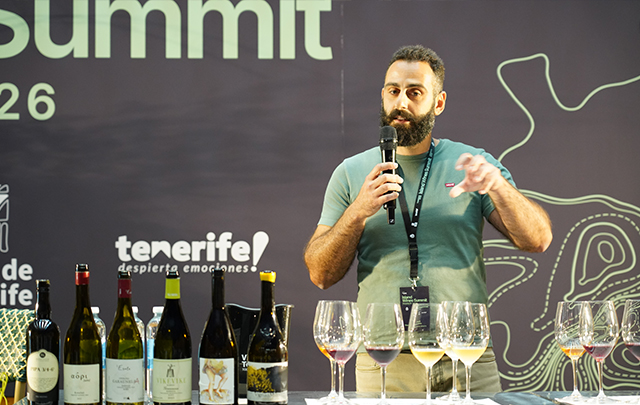
Starting from the premise that the Mediterranean “is the region with the greatest cultural density on the planet, where, amidst all the diversity, there is a common thread: the human touch”, the sommelier and founder of Ithaca Wines Bernat Voraviu took the audience on a journey through the wines of the Mediterranean islands, demonstrating that “although they speak different languages, they share a common sense of identity”. The human touch, and its interpretation. That is why, when discussing Mediterranean wines, the Catalan sommelier has not only brought the wines themselves but also the people who make them, as “terroir is nothing more than the human interpretation of the territory”. He was joined on stage at the Island Wines Summit by Simone Sedilesu (founder and winemaker at Cantina Vikevike, Barbagia, Sardinia), Yiannis Kyriakidis (winemaker at Vouni Panayia Winery, Cyprus), Aimilios Andrei (co-founder of Aôri Winery, Crete, Greece) and Andrea Foti (winemaker and producer at I Vigneri, Etna, Sicily). All of them are representatives of the new generation of Mediterranean island wines who have demonstrated that the sector’s future is bright and committed to producing “wines with less density and a pursuit of finesse which, despite all their differences, the new Mediterranean wines share”. Wines produced with minimal intervention; with investment not so much in machinery “but in people’s knowledge”, as Foti emphasised; or with 100% organic production, such as Kyriakidis’s; Mediterranean wines continue to make their mark.
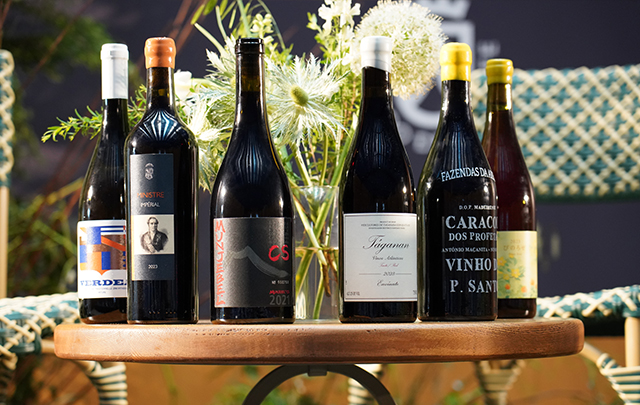
The Atlantic tour was led by sommelier Paz Levinson, executive sommelier at Groupe Pic (Paris, France), with the assistance of Canarian producers and also the Portuguese winemaker Antônio Maçanita (Bodega Antônio Maçanita, Azores, Portugal). As a sommelier in a country with a rich winemaking tradition that is opening up to wines from other regions, Levinson wished to highlight “the importance of the restaurant as a window onto new offerings. The restaurant can be a school, it can be a source of inspiration and open up the market for those wines that are crafted with care and have a story to tell”. He notes that this is already happening in Tenerife with producers such as Jonatan García Lima (Suertes del Marqués) and Roberto Santana (Bodega Envínate), who uphold tradition by using the braided trellis, “a unique vine-training system that is very much our own”, as well as the vineyard itself and what it offers: “its volcanic soils and the microbiota of its surroundings”.
The event also aimed to offer a closer look at one particular type of island wine: sweet wines. To this end, it featured Matteo Montone, Master Sommelier and current head of wines at the Estelle Group (London). During his talk, the Italian sommelier emphasised that island sweet wines are so special because “they combine history, geographical uniqueness and an enormous capacity for ageing”. Montone illustrated his points with a selection of sweet wines from Tenerife, Sardinia, Sicily, Kefalonia and Santorini.
A recurring theme throughout the day was the uniqueness of the islands’ vineyards and how they are cultivated – that ‘heroic viticulture’ of the islands. This was the focus of the day’s final round-table discussion, during which Master of Wine Fernando Mora proposed “the challenge of recognising their value”. Mora, who also heads Bodegas Frontonio (Aragón), was joined by the winemakers Antônio Maçanita (Bodega Antônio Maçanita, Azores, Portugal), Borja Pérez (La Guancha, Tenerife) and the sommelier Rodrigo González, from the Tenerife restaurant Kensei. As well as acknowledging island agriculture, all the speakers also agreed on highlighting “the ageing potential of island wines, resulting in great wines that can stand the test of time”.
Related news
News
The Island Wines Summit in Tenerife is fostering a global community with a promising future for island wines
News
Volcanoes, the sea, and century-old vineyards: an in-depth look at Tenerife’s wines
News
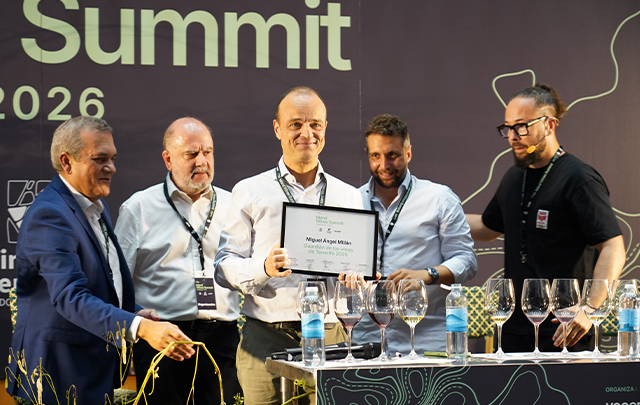
Miguel Ángel Millán, Guardian of Tenerife Wines 2026
News
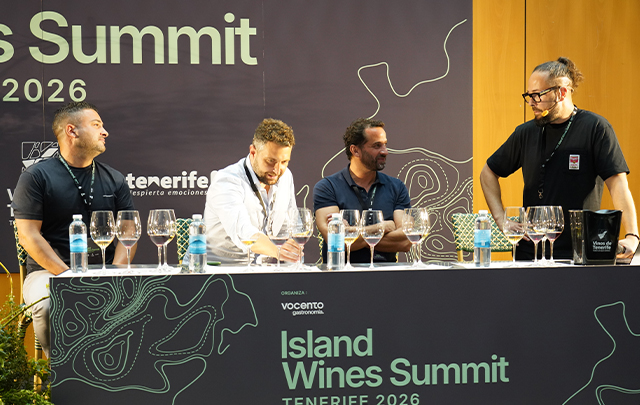
Island status as a refuge for the Atlantic wine-growing heritage
News
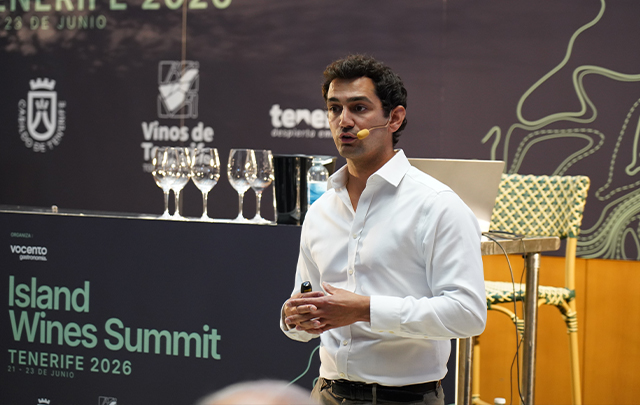
Four Islands in Five Sweet Wines
News
The minerality of wine as a neurosensory experience
News
Island wines: the present and future in your glass
News
The Mediterranean in a Glass: identity, volcanoes and islands in a thrilling tasting experience
News
Island wines according to Pascaline Lepeltier: from a fragmented reality to a global category
News